Staff Responsibility for IT Support
IT is an asset and a resource that needs managing and looking after in just the same way as your building, your staff and your funding. It often makes most sense to give one person the main responsibility for ensuring that your computer systems work effectively, and to make them your IT manager or IT support worker.
Support falls into two broad areas. Users need support, in order to ensure that they are using IT effectively and to help them recover from the inevitable problems. The system itself needs support to cope with breakdowns and routine maintenance.
As a rule of thumb, you could expect to need one full-time IT support person for 50 staff members. If you have 10 staff, therefore, it would be reasonable to expect someone to allocate one day a week to this task.
The job description for an IT co-ordinator or IT support worker could include:
- acting as systems manager for your network (if you have one)
- providing IT support to computer users within the office (including inducting new staff)
- initial troubleshooting of IT problems, and resolving them wherever possible
- ensuring that data is routinely backed up
- ensuring that all staff are able to organise their computer files in an effective way whether they are shared or for individual use
- managing the distribution of documents in electronic format and of standard layouts and templates for documents
- ensuring that software licences are adhered to
- overseeing computer security and Antivirus precautions
- acting as Data Protection Officer (although under the 1998 Act this is no longer exclusively an IT issue)
- liaising with external support (the link person)
- keeping a log of all IT problems with their resolution
- keeping an inventory of all computer equipment, keeping maintenance records, and ensuring adequate maintenance provision
- identifying bottlenecks and problems, making recommendations to solve them, keeping standard software and hardware recommendations under review, and providing input into future IT strategy.
External Support
Few organisations have the resources to cover all their IT support needs in-house. Some issues, like network troubleshooting, require a high level of specialist skill and are only required periodically; it isn’t cost effective to develop the necessary expertise in-house. You cannot, however, contract out everything. Some problems or routine operations are too simple, too frequent, or too urgent for that.
You need to find a balance, where in-house staff deal with basic day-to-day issues and call on external specialists for more complex problems.In striking the balance, much will depend on the size of your agency and the complexity of its computer systems. Larger organisations are more likely to have enough work to justify employing a full- or part-time member of staff, but even these will contract out elements of their IT support.
Whatever your detailed decision, your in-house IT support worker must have adequate training to carry out their role and to enable them to communicate effectively with external services.
Internet use policy, sample internet policies, standard internet use policy, strict internet use policy
Internet Use Policy
Sample Internet PoliciesThe sample Internet Access Policies (IAP) listed below can get you started creating an acceptable Internet use policy for your organization.
Standard Internet Use/Access Policy
<<company>>
Computer Network and Internet Access Policy
Disclaimer
The Internet is a worldwide network of computers that contains millions of pages of information. Users are cautioned that many of these pages include offensive, sexually explicit, and inappropriate material. In general, it is difficult to avoid at least some contact with this material while using the lnternet. Even innocuous search requests may lead to sites with highly offensive content. Additionally, having an e-mail address on the lnternet may lead to receipt of unsolicited e-mail containing offensive content. Users accessing the lnternet do so at their own risk and the <<company>> is not responsible for material viewed or downloaded by users from the Internet. To minimize these risks, your use of the Internet at <<company>> is governed by the following policy:
Permitted Use of Internet and Company computer network
The computer network is the property of <<company>> ("Company") and is to be used for legitimate business purposes. Users are provided access to the computer network to assist them in the performance of their jobs. Additionally, certain employees ("Users") may also be provided with access to the Internet through the computer network. All Users have a responsibility to use Company’s computer resources and the Internet in a professional, lawful and ethical manner. Abuse of the computer network or the Internet, may result in disciplinary action, including possible termination, and civil and/or criminal liability.
Computer Network Use Limitations
PROHIBITED ACTIVITIES. Without prior written permission from Company, the Company’s computer network may not be used to disseminate, view or store commercial or personal advertisements, solicitations, promotions, destructive code (e.g., viruses, trojan horse programs, etc.) or any other unauthorized materials. Occasional limited appropriate personal use of the computer is permitted if such use does not a) interfere with the user’s or any other employee’s job performance; b) have an undue effect on the computer or company network’s performance; c) or violate any other policies, provisions, guidelines or standards of this agreement or any other of the Company. Further, at all times users are responsible for the professional, ethical and lawful use of the computer system. Personal use of the computer is a privilege that may be revoked at any time.
ILLEGAL COPYING. Users may not illegally copy material protected under copyright law or make that material available to others for copying. You are responsible for complying with copyright law and applicable licenses that may apply to software, files, graphics, documents, messages, and other material you wish to download or copy. You may not agree to a license or download any material for which a registration fee is charged without first obtaining the express written permission of the company.
COMMUNICATION OF TRADE SECRETS. Unless expressly authorized to do so, User is prohibited from sending, transmitting, or otherwise distributing proprietary information, data, trade secrets or other confidential information belonging to Company. Unauthorised dissemination of such material may result in severe disciplinary action as well as substantial civil and criminal penalties under state and federal Economic Espionage laws.
Duty not to Waste or Damage Computer Resources
ACCESSING THE INTERNET. To ensure security and avoid the spread of viruses, Users accessing the Internet through a computer attached to Company’s network must do so through an approved Internet firewall or other security device. Bypassing Company’s computer network security by accessing the Internet directly by modem or other means is strictly prohibited unless the computer you are using is not connected to the Company’s network.
FRIVOLOUS USE. Computer resources are not unlimited. Network bandwidth and storage capacity have finite limits, and all Users connected to the network have a responsibility to conserve these resources. As such, the User must not deliberately perform acts that waste computer resources or unfairly monopolize resources to the exclusion of others. These acts include, but are not limited to, sending mass mailings or chain letters, spending excessive amounts of time on the Internet, playing games, engaging in online chat groups, uploading or downloading large files, accessing streaming audio and/or video files, or otherwise creating unnecessary loads on network traffic associated with non-business-related uses of the Internet.
VIRUS DETECTION. Files obtained from sources outside the company, including disks brought from home, files downloaded from the Internet, newsgroups, bulletin boards, or other online services; files attached to e-mail, and files provided by customers or vendors, may contain dangerous computer viruses that may damage the company’s computer network. Users should never download files from the Internet, accept e-mail attachments from outsiders, or use disks from non-Company sources, without first scanning the material with Company-approved virus checking software. If you suspect that a virus has been introduced into the Company’s network, notify Company immediately.
No Expectation of Privacy
Employees are given computers and Internet access to assist them in the performance of their jobs. Employees should have no expectation of privacy in anything they create, store, send or receive using the company’s computer equipment. The computer network is the property of the Company and may be used only for Company purposes.
Waiver of privacy rights. User expressly waives any right of privacy in anything they create, store, send or receive using the company’s computer equipment or Internet access. User consents to allow company personnel access to and review of all materials created, stored, sent or received by User through any Company network or Internet connection.
Monitoring of computer and Internet usage. The Company has the right to monitor and log any and all aspects of its Computer system including, but not limited to, monitoring Internet sites visited by Users, monitoring chat and newsgroups, monitoring file downloads, and all communications sent and received by users.
Blocking Sites With Inappropriate Content
The Company has the right to utilize software that makes it possible to identify and block access to Internet sites containing sexually explicit or other material deemed inappropriate in the workplace.
Acknowledgement of Understanding
I have read and agree to comply with the terms of this policy governing the use of <<company>>’s computer network. I understand that violation of this policy may result in disciplinary action, including possible termination and civil and criminal penalties.
———————— ——————–
Signature Date
————————————————-
Printed nameStrict Internet Use/Access Policy
<<company>>
Computer Network and Internet Access Policy
Disclaimer
The Internet is a worldwide network of computers that contains millions of pages of information. Users are cautioned that many of these pages include offensive, sexually explicit, and inappropriate material. In general, it is difficult to avoid at least some contact with this material while using the lnternet. Even innocuous search requests may lead to sites with highly offensive content. Additionally, having an e-mail address on the lnternet may lead to receipt of unsolicited e-mail containing offensive content. Users accessing the lnternet do so at their own risk and the <<company>> is not responsible for material viewed or downloaded by users from the Internet. To minimize these risks, your use of the Internet at <<company>> is governed by the following policy:
Permitted Use of Internet and Company Computer Network
The computer network is the property of <<company>> ("Company") and may only be used for legitimate business purposes. Users are provided access to the computer network to assist them in the performance of their jobs. Additionally, certain employees ("Users") may also be provided with access to the Internet through the computer network. All Users have a responsibility to use Company’s computer resources and the Internet in a professional, lawful and ethical manner. Abuse of the computer network or the Internet, may result in disciplinary action, including possible termination, and civil and/or criminal liability.
Computer Network Use Limitations
PROHIBITED USES. Without prior written permission from Company, the Company’s computer network may not be used to disseminate, view or store commercial or personal advertisements, solicitations, promotions, destructive code (e.g., viruses, self-replicating programs, etc.), political material, pornographic text or images, or any other unauthorised materials. Employees may not use the Company’s Internet connection to download games or other entertainment software (including screen savers), or to play games over the Internet. Additionally, you may not use the computer network to display, store or send (by e-mail or any other any other form of electronic communication such as bulletin boards, chatrooms, Usenet groups, etc.) material that is fraudulent, harassing, embarrassing, sexually explicit, profane, obscene, intimidating, defamatory or otherwise inappropriate or unlawful. Furthermore, anyone receiving such materials should notify their supervisor immediately.
ILLEGAL COPYING. Users may not illegally copy material protected under copyright law or make that material available to others for copying. You are responsible for complying with copyright law and applicable licenses that may apply to software, files, graphics, documents, messages, and other material you wish to download or copy. You may not agree to a license or download any material for which a registration fee is charged without first obtaining the express written permission of the company.
COMMUNICATION OF TRADE SECRETS. Unless expressly authorized to do so, User is prohibited from sending, transmitting, or otherwise distributing proprietary information, data, trade secrets or other confidential information belonging to Company. Unauthorized dissemination of such material may result in severe disciplinary action as well as substantial civil and criminal penalties under state and federal Economic Espionage laws.
Duty Not to Waste Computer Resources
ACCESSING THE INTERNET. To ensure security and avoid the spread of viruses, Users accessing the Internet through a computer attached to Company’s network must do so through an approved Internet firewall or other security device. Bypassing Company’s computer network security by accessing the Internet directly by modem or other means is strictly prohibited unless the computer you are using is not connected to the Company’s network.
FRIVOLOUS USE. Computer resources are not unlimited. Network bandwidth and storage capacity have finite limits, and all Users connected to the network have a responsibility to conserve these resources. As such, the User must not deliberately perform acts that waste computer resources or unfairly monopolize resources to the exclusion of others. These acts include, but are not limited to, sending mass mailings or chain letters, spending excessive amounts of time on the Internet, playing games, engaging in online chat groups, uploading or downloading large files, accessing streaming audio and/or video files, or otherwise creating unnecessary loads on network traffic associated with non-business-related uses of the Internet.
VIRUS DETECTION. Files obtained from sources outside the company, including disks brought from home, files downloaded from the Internet, newsgroups, bulletin boards, or other online services; files attached to e-mail, and files provided by customers or vendors, may contain dangerous computer viruses that may damage the company’s computer network. Users should never download files from the Internet, accept e-mail attachments from outsiders, or use disks from non-Company sources, without first scanning the material with Company-approved virus checking software. If you suspect that a virus has been introduced into the Company’s network, notify Company immediately.
No Expectation of Privacy
Employees are given computers and Internet access to assist them in the performance of their jobs. Employees should have no expectation of privacy in anything they create, store, send or receive using the company’s computer equipment. The computer network is the property of the Company and may be used only for Company purposes.
WAIVER OF PRIVACY RIGHTS. User expressly waives any right of privacy in anything they create, store, send or receive using the company’s computer equipment or Internet access. User consents to allow company personnel access to and review of all materials created, stored, sent or received by User through any Company network or Internet connection.
MONITORING OF COMPUTER AND INTERNET USAGE. The Company has the right to monitor and log any and all aspects of its Computer system including, but not limited to, monitoring Internet sites visited by Users, monitoring chat and newsgroups, monitoring file downloads, and all communications sent and received by users.
BLOCKING SITES WITH INAPPROPRIATE CONTENT. The Company has the right to utilize software that makes it possible to identify and block access to Internet sites containing sexually explicit or other material deemed inappropriate in the workplace.
Acknowledgement of Understanding
I have read and agree to comply with the terms of this policy governing the use of <<company>>’s computer network. I understand that violation of this policy may result in disciplinary action, including possible termination and civil and criminal penalties.
———————— ——————–
Signature Date
————————————————-
Printed name
CPH非赢利主机服务
CPH 是 CBN and 72pines united host 的缩写,即“七十二松及CBN联合主机服务”。官方网址是 http://www.72pines.net,技术支持论坛为:http://support.72pines.net 。
本着提供国内最好的个人主机的目的,由CBN提出概念,72pines提供方案和技术支持的公益性质独立主机服务。目前一台DELL 1950服务器托管在北京酒仙桥BGP机房,运行于Debian Linux操作系统之上。使用CPH主机服务的用户需要缴纳服务器的成本费用(一年300元)。
DELL PowerEdge 1950详细配置见这里,在标配基础上加到了2×Xeon 5110处理器,2×146G SAS硬盘,2×电源,4G ECC DDR2内存。
托管公司选择的是网宿科技,酒仙桥BGP机房也 是北京的优秀核心机房,托管费平均比一般机房贵3000元一年,BGP带宽也非常昂贵,因为BGP有个好处就是南北网通电信访问速度都比较理想,特别是教 育网,更是飞快,北京教育网访问能达到10M,一般也是4M左右。但现在我们托管的带宽只是100M共享,北京地区的IDC限制带宽非常严,只能使用1- 2M的带宽,而独占带宽的话,1M一年大概需要1万元左右,所以我们限制每个用户每月的流量为 20G,空间的话是 1G。
Powered by ScribeFire.
Grt Free web hosting
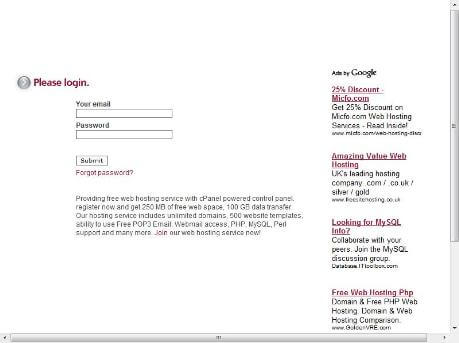
http://www.000webhost.com/members/login.php
Providing free web hosting service with cPanel powered control panel. register now and get 250 MB of free web space, 100 GB data transfer. Our hosting service includes unlimited domains, 500 website templates, ability to use Free POP3 Email, Webmail access, PHP, MySQL, Perl support and many more.
£1 第一年的便宜空间
如果你只需要一年的空间,没有比这个更好的了。
- 10 free domains
(co.uk., .eu, .com, .net, .org, .info, .biz)
- NEW: Free Adobe® Software
- 20 GB web space/100 GB traffic
- 5,000 E-mail accounts
(1 GB per account)
- STRATO Communicator (webmail)
- STARTO Website builder
- AntiSpam & AntiVirus included
- STRATO ProBlog
- PHP, Perl, CGI, Python, Ruby, Cron-Jobs
- 18 MySQL databases and BackupControl
- Secure Shell
* Special offer on all hosting packages valid until 30.06.2007. One package per customer. £1 for first 12 months (£1.19 incl. VAT), thereafter normal price: EasyWeb for £3.49 per month (£4.15 per month incl. VAT); PowerWeb £6.99 per month (£ 8.32 per month incl. VAT); AdvancedWeb for £10.99 per month (£13.08 per month incl. VAT); EnterpriseWeb for £14.99 per month (£ 17.84 per month incl. VAT). Standard contract/billing period - EasyWeb 12 months; PowerWeb / AdvancedWeb 6 months; EnterpriseWeb 3months. MailDomain: set up fee of £3.29 (£3.92 incl. VAT). Shipping fee of £3.99 (£4.75 incl. VAT) for software orders.